Showing posts with label Africa conservation.. Show all posts

Tuesday, April 3, 2012

Poacher's Moon.


There were stars that I once wished upon.
There was the moon, my guiding light.
They were signs that God was watching
Over all my friends each night.
But now a poacher's moon is rising
In this cloudless starry sky,
There's an evil hand stalks across this land:
Another rhino tonight will die.
So take the stars out of the heavens.
Take the moon down from the skies.
My friends now need the darkness,
In the darkness they must hide.
There's a cross for all who've fallen,
I hold a vigil by candlelight.
There's a prayer I share with those who care-
"Keep Our rhino safe tonight."
So take the stars out of the heavens.
Take the moon down from the skies.
The moon that was once my guiding light
Brings me misery tonight.
'Cause there's a poacher's moon now rising,
Death stalks the bright moonlight.
If another dies, I'm going to cry,
My heart will break tonight.
I'd take the stars out of the heavens.
I'd take the moon down from the skies.
I would mix them with all my tears and fears-
A magic shield so they can hide.
So take the stars out of the heavens.
Take the moon down from the skies.
Please God we need your blessings,
"Keep Our rhino safe tonight."


The inspiration for this post lies with some verse I sent to Ray Kieran, but the real genesis is the work that other rhino conservation activists are doing each full moon with a cross planting in Cape Town, South Africa to highlight all those rhino slaughtered merely because of Asian demand for their horn for Chinese Traditional Medicine beliefs.
Please read and share this group's work-
Planting Crosses For Fallen Rhino

 You can read more about this tragic situation of rhino poaching here-

This is the picture that inspired the above words-


Another cross planting takes place for this coming Poacher's Moon- 6th April.
Credits:
Ray Kieran.
The above poetry arose out of a conversation with Ray Keiran, a rhino conservation activist on OSCAP Facebook group-(Outraged SA Citizens Against Poaching).  I sent her a few lines and Ray was ecstatic over the words and meanings captured by them. So I developed the verses from those simple lines and sat on this poem for a few weeks seeking out suitable images to illustrate this with. 

 Ciske Kruger.
Then I approached Ciske Kruger, another gifted activist from OSCAP, sent her the words and asked her if she could interpret the words with romantic yet tragic imagery hoping the lyrics would inspire something special to include in this post. Ciske then posted these images on various Facebook groups where they received rapturous applause - as they should. And at the same time sent me the same images, less the text that appears in the originals. I asked Ciske to add crosses into her artwork!
Thanks Ray and Ciske!

Oh and keep checking this site...maybe these lyrics start something else!

Travel Photo Thursday is on again where travel bloggers post up their great pics from around the world. Join us! Head over to Nancie's  travel-photo-thursday-april-5-2012 and post up your travel photo and link into the fun!


Share/Bookmark

Sunday, March 4, 2012

I've Been Running....


I've been running on fast with the utter desperation
of trying to escape that image of tragedy.
I'm haunted right now by the sight of mutilation
of the mother who once loved and nurtured me.


I've been running on looking for some deep shading cover,
need to get some shelter over me.
Helicopter's close and soon they're gonna discover
just another wee frightened refugee.


They've got high powered guns.
They've got thermal imaging technology.
They've got tranquilizer drugs
and sharpened machetes.
So there's nowhere to run!
Nowhere a safe retreat!
Panicked and stunned:
just another...
 desperate refugee.

I've been running on low and feeling that deep exhaustion,
panicking with the loss of energy.
But driven on now by the thought of extermination
of the mother that once loved and protected me.


I've been running on long from the stink of the decimation.
Horns are going to be the death of me.
Anyone hear, can you enforce the regulations
on the killers of the mother that once cared for me?

Let's get more APU teams moving.
Let's find the funds -
for high powered guns!
And get those prosecutions moving!
No bail for these -
just throw away the keys.
Don't allow no smooth talking lawyers
in a world that treats poachers so leniently.


Or there's...
nowhere to run.
Nowhere a safe retreat.
Hunted and gunned:
just another...
disappeared specie.


Rhino poaching total for 2007 in South Africa was 13.

2011 saw 488 kills.

At the time of writing this post, already the total for 2012 is now 94!  Total now 109!  119!
Edited 23/3/12. Now 139!
over 300!
The overall world total will be higher.

For more information on why rhino poaching is escalating read -
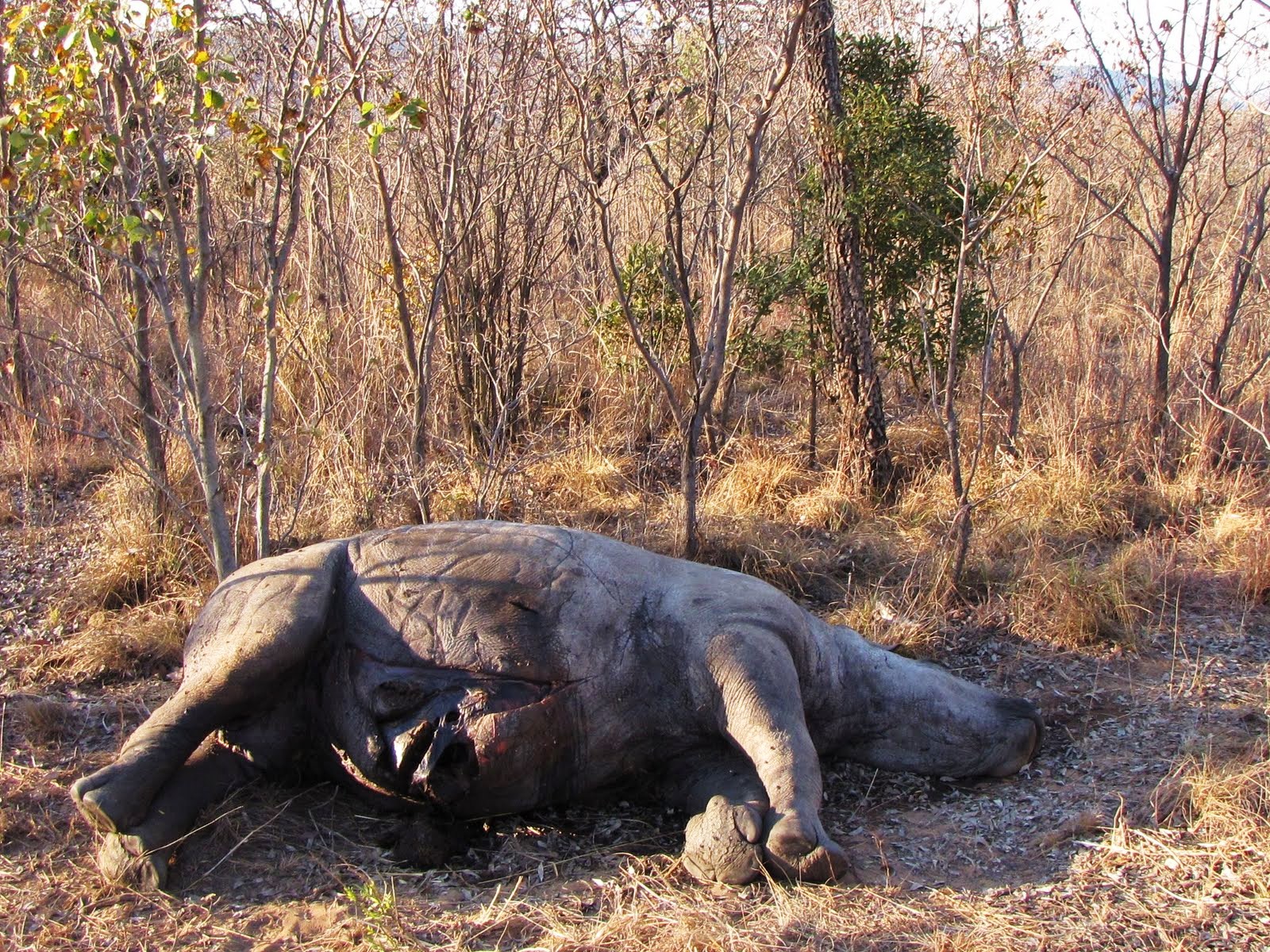
Graphic Images from The Rhino Wars

Pictures of rhino calf are by 
Pam Krzyza of Outraged South African Citizens Against Poaching.

Join OSCAP here- https://www.facebook.com/groups/OSCAP/


Share/Bookmark

Tuesday, January 31, 2012

Warning: Graphic Images From The Rhino Wars!


"Why do you want my horn?"

Rhino horn is used in Traditional Chinese Medicine where it is ground up, then infused in boiling water and prescribed as a treatment for fever, rheumatism, gout and other disorders. It is also mistakenly believed to be an aphrodisiac. Now fetching $65,000 a kilo in Asia, a 6kg horn valued at $380,000 is powerful incentive for criminal Asian syndicates to fund illegal poaching operations in Africa and Asia. Corruption at various levels of Governments and all along the supply chain is extremely difficult to combat.  

Photo: Jim McIntosh
Scientifically, rhino horn is Keratin, the same as our hair, toe or fingernails. 
It has no medicinal benefits, but old beliefs, new rumours that rhino horn cures cancer, coupled with rising Chinese and Vietnamese affluence are driving up demand. Poaching skyrocketed after an ex-premier of Korea claimed in 2008 that rhino horn cured their cancer. Elle MacPherson, in 2010, stupidly quipped she used it as an anti-ageing cure. However the biggest myth-booster since 2007 has come from the Chinese government investing heavily in boosting its Traditional Chinese Medicine industry. And that is putting endangered wildlife everywhere under immense pressure. factsanddetails.com/china

The myth is growing that rhino horn cures almost anything. Criminal syndicates and TCM producers of rhino horn ''cures" boost this myth to drive up the demand and prices to make more profits. While many TCM organisations may openly state it is against their organisations' principles, human greed is what it is and unscrupulous members may still be involved. 
  
Rhino horn is not medicine!

Once rhino were found across Africa, Asia, North America and into Europe, now they are down to less than 27,000. How can rhino survive this onslaught?

Three species are critically endangered. 
The World's population today of the 5 species of rhino- White rhino: 20,000, Black rhino: 4,500, Greater One-horned rhino: 2,800, Sumatran Rhino: 200, Javan Rhino: 44. These figures are best estimates: some argue they are way too high. Plus if poaching continues its rapid escalation, losses from illegal kills will outstrip current natural breeding increases achieved with hard fought conservation programs over the past 40 years with Africa's White and Black Rhino.

In South Africa dedicated volunteers are being trained and deployed in game reserves to patrol and protect rhino. We are begging, pressuring, and petitioning governments to help fund the Anti-Poaching Units, and to effectively bring the criminal organisers to justice. The South African prosecution rates are abysmal with less than 5% of charges resulting in successful prosecutions, most of those against the lowest echelon of poachers -the poor poverty driven local poacher, - the ''minnows'' who are easily replaced. 
The organisers of the poaching rings need to be targeted worldwide with all resources available.
This is a responsibility of all governments, but the South African government needs show leadership and demonstrate its commitment to protecting its major tourism jewels - its wildlife! 

Photo: Wendy Warwick, Krugersdorp Game Reserve.
Meantime rhino are shot.

We are trying to get more APU's on the ground. They are very effective, and have captured many poachers. Some have been shot at themselves. They lay their lives out there with them.

Photo of  Umfurudzi Game Park staff inspection team by Jan Stander.
Rhino are trapped by wire snares that horrendously injure them and cause a long, slow death.

APU, SANParks and Game Reserve staff remove hundreds of illegal, cruel wire snares every day laid by local poachers.

At the other end of the scale, poaching is very quick and high tech, carried out by ex-military, ex-policemen, professional hunters and veterinarians using helicopters, latest thermal-imaging technology, tranquillizer dart guns, and chainsaws: very speedy and hard to combat unless APU's monitor rhino 24/7.


Chainsaws remove the horn from the drugged but living rhino, leaving it to wake to a living hell! TCM values the horn removed from a live rhino higher.

Calves are killed also.
The brutality by humans is unbelievable. Who deserves this planet?

Killing the calves means there are less rhino around which sends the price higher for each horn which drives the killings up by making it more profitable. A vicious circle. The Rhino War is heating up!

You can help!
There is a growing world movement of concerned groups that more people are joining to help end the slaughter. Rhino protection groups are in the forefront of pressuring governments to stop poaching now, by funding APU's, and to target the criminal organisers to bring an end to this appalling trade.

Anyone can search Facebook or Google search for rhino protection groups to join.

We need you to join facebook.com/groups/saveourrhino/ 

"Who cares for the calves that do survive a slaughter?"

Every caring game reserve owner will take on the task of caring for the young.  

In Kenya, the Sheldrick Wildlife Trust cares for young rhinos and many orphan elephant calves. You can donate or even adopt any of the orphans. We have adopted 2 orphan elephants and each month we receive updates on their progress. Visits there are welcome. 


Stopping the trade is the responsibility of all governments, but the South African government needs to show leadership, and demonstrate its commitment to protecting its major tourism jewels - its wildlife! 


Sorry about the horrible graphic images, but this is the reality of the Rhino Wars.
We need the plight of rhino shared everywhere!
Use the share buttons below. Please!


Share/Bookmark

Friday, December 9, 2011

Empty Silence Is Not A Natural Sound: Hunter's Insomnia.


I raise my head up off the red dirt ground
To watch the fiery sun go down.
Where once I would sleep soundly in the black depths
To the lions roaring sound,
If we heard the comfort of branches snap and crackle,
We knew the big eles were around.
Now no leopard coughs, no jackal yelps, no hyena sarcastic laugh,
Awake, I cannot lay me down.
All around the vacant silence disturbs me,
This empty silence is not a natural sound.

We climbed the rocky koppies to search in vain,
Where once the great migration filled our gaze.
The scorched ground now barely fertile
Where the blood and bone decays.
There the scant grass grows the sweetest,
Cattle scatter skeletons to graze.
The curse of the charcoal-burners
Infesting the horizon with their smoky haze.
Gone are acacia-thorn and spreading shepherd trees
Under whose shade umbrellas we would laze.
Once we could look across the savannah,
Where the massive herds would parade.

The bribery for trophy permits we would pay
Far more than we would ever dare to tell.
We sent the big tuskers to their grave,
Rhino, lion, leopard - Ah, what the hell!
Anything in our way!
Oh, the hyena and vultures prospered swell!
Now within my massive halls so heavily adorned,
I brag, my courageous tales I tell,
My walls covered with those rare horned,
I got them before their last death knell.

Therein, I rest and slumber oh, so well!


http://www.all-creatures.org/hope/anti-th-20080320.htm


Share/Bookmark

Tuesday, December 6, 2011

Who Are The Beasts?


Photo Courtesy David Sheldrick Trust.


Shukuru,
Elephant of the great heart.
Once an orphan, still a child,
Now you play the mother's part.
Do you remember how you lost your mum,
Leaving you the traumatised one?
Now Kithaka feels your consoling trunk,
And loving heart.
What guides the love you now impart?
Is that just instinct?
Or intelligent art?

Shukuru,
Elephant of the great soul.
You need take on the mother's role.
Do you whisper? " I know the pain.
But here you're with family again."
As poachers take their deadly toll,
The killing soars out of control,
To satisfy the Chinese role.
That bloody trade, so inhumane!
When will it end?
What will remain?

Shukuru,
Elephant of the loving heart,
You show us how the healing starts.
This photo now just sent to me
Of human made refugees,
Provokes my thought, how can it be,
That man feels such superiority
Over the lowly beasts?
When it comes to love and morality,
Who knows the most? 
Who knows the least?

Elephant intelligence, social behavior, and family concern can show we humans a lot.
Read about elephant's intelligence and complex social codes here- Elephant intelligence

How is it, that young orphans themselves, welcome a strange orphan to their young herd?
Why can we not believe they have the intelligence to recognize what each new orphan has been through, and can console another to recover from trauma?

Who are the beasts?

 Shukuru is an orphan we adopted soon after she arrived at David Sheldrick Trust, Kenya. Now this 2 year old is welcoming new arrivals and ably taking on a mother's caring role of a new rescue - Kithaka.
Read the orphan stories herehttp://www.sheldrickwildlifetrust.org/asp/orphans.asp one of the leading elephant and rhino sanctuaries in Africa.
 Our plan is to visit the sanctuary in Nairobi, hopefully as early as July 2012. It's a big buzz to read about about our adopted ele orphans in each monthly report; we really look forward to them!
For a small annual amount you too can help in saving Africa's wildlife. When we all work together we make a big difference.


Share/Bookmark

Sunday, September 4, 2011

Magnificent Monday: Conservation. Sept 5th

Conservation: What can we do?

Photo Courtesy SOS Elephants of Chad.
Sad and shocking isn't it!

That such a wonderful huge elephant, one of God's great creatures is killed for its teeth to make ivory chopsticks, seals and carvings; mere trinkets for demanding Asian buyers. Chinese and Vietnamese backed criminal syndicates are ruthlessly raping wildlife in many parts of the world, endangering species such as African elephants, rhino, lions, and many other animals such as Asia's tiger.

Check out the extent of the problem at these links-
"People are being killed in the field trying to kill elephants, government officers are being killed as well by poachers, this trade is encouraging massive corruption in Africa and people are being bribed and removed in order to get the stuff out of the continent and over to China," Martin said.

Will elephant, rhino, lion, and tiger exist in the wild in a decade?

Drugged by poachers, this Asian rhino
 survived only a few days even with treatment. 

Rising affluence in Asia, particularly China, ensures a growing market and demand for ivory, pushing up prices, and encouraging corruption. And not just ivory; the growth of Traditional Chinese Medicine is causing  rhino killings in Africa and Asia at an alarming rate. Poaching for their horns threatens their survival as a species. Tigers are critically endangered in Asia because of CTM demand for body parts; now Africa's lion parts are on-sold from 'canned hunting' as a substitute, fuelling profitable returns for this disgraceful industry that should be totally banned. Lions were estimated to number 200,000 in the 1970's, now down to less than 20,000 throughout Africa.


Poaching needs to be urgently addressed by a multi national approach. Completely banning the ivory trade is a start. Kenya recently burnt 5 tons of ivory to send a message that ivory is useless except as teeth in a living elephant, and that the ivory trade should be totally banned. BBC News
 For this to happen China needs to crackdown on its ivory trade and its cultural ideals need to change. Chinese Traditional Medicine needs to accept rhino horn has no more medicinal value than toenail parings! 

Meantime I have joined the Jim McIntosh inspired ''Ban Travel to China" movement.
Anybody else can join - it's free. Just take the pledge and blog it to spread the word and save an elephant or rhino from destruction. Stuff China - plenty of other places to travel.

Human encroachment on wild areas is another cause of falling wildlife numbers.

That extra land comes at the cost of diminishing wilderness, putting pressure on animal numbers as they are pushed into ever decreasing areas. Closer human contact spreads domestic animal diseases to wildlife.

How do we protect wildlife, and at the same time find more land for the growing human population  to farm, or raise crops for their existence?
Many organisations are dedicated to solving human-wildlife conflict by educating local communities to change their attitudes to what they see as merely pests, crop marauders or meat on the hoof. New strategies are being developed: chili peppers inter planted with crops; bee hives along fence lines; introducing Kangal dogs as sheepdogs for Namibian farmers.
And of course, my pet project, Elephant-Human Relations Aid, EHRA in Namibia build rock wall water-point protection. I have volunteered twice.
Just a few ideas, and organisations needing support and funding to carry out badly needed conservation work within local communities.
This is how I want to see elephants. Photo by J McIntosh. Chobe National Park.

What can I do?

* Supporting Chobe Wildlife Rescue financially and by promoting them through Social Media.

* I have re-newed our adoption subscription at N/a'an Kuse' for Lilly the African Painted Dog.
N/a'an Kuse' are establishing a re-introduction to the wild program for these critically endangered Wild Dogs.

Our adopted baby ele Turkwell, at left.
* I have just re-newed our baby elephant adoption subscriptions at  sheldrickwildlifetrust.org . Check this important wildlife conservation organisation out. Not only do they rescue and rehabilitate elephant calves after their mothers have been killed by poachers, but they operate within the community to encourage locals to value and protect Africa's diminishing wildlife. However with Asian demand for ivory pushing prices sky-high, some locals will be tempted to value a quick dollar over protecting an elephant.

* Holes In My Soles will become more centred on wildlife preservation.
I'll not just be writing about our travels, but also publicising organisations at the coalface of wildlife conservation. This will better reflect my passion, and my style of travelling.

*My future travels will continue to be a mix of volunteer and wildlife experience.
Galapagos Islands is next.

How can travellers help?

*Avoid buying anything made of ivory.

*Don't buy fur or exotic hide clothing or footwear. Snake or lizard skin for example.

*Avoid indulging in cultural practices that exploit wildlife. Think about that fresh snake blood drink you macho'ed on in Vietnam. Visit an elephant sanctuary instead of taking that elephant safari in Cambodia or Nepal.

*Join a wildlife volunteer project as your next travel experience.

*Highlight these issues by writing about them to encourage discussion and spreading of awareness.

*Value all wildlife as precious gifts to share this planet with.
.


Share/Bookmark

Thursday, August 18, 2011

The Most Beautiful Dog You Will See!

Lilly, at Naankuse. Isn't she a stunner! A big, beautifully patterned girl. Photo by Naankuse.
 Lilly is one of a pack of 14 African Painted Dog  pups taken in early last year by Naankuse. You can read about this in an earlier post - Who let dogs out.

 The African Painted Dog, Lycaon pictus, also referred to as African Wild Dog or Cape Hunting Dog, once numbered over 500,000 across 39 countries, but now there are only about 3,000-5,500 in perhaps 14 countries. As wilderness areas lessen due to human encroachment, wildlife is pushed into smaller and unconnected areas, numbers fall too low, scattered pockets of survivors cannot mate with new 'blood' and the gene pool is diluted in strength. The pack may be cut off from infusions of new, stronger genes. This lack of new gene infusion is now identified as a prime cause of falling numbers of many species, such as lions. Nature's way survival of the fittest by inheriting new stronger genes has been interfered with by human encroachment.

 Lilly pictured above, is named after our own mongrel. She is one of 14 Wild Dog pups taken in last year by Naankuse, a wildlife sanctuary and re-rehabilitation centre just east of Namibia's capital Windhoek. The critical level of Wild Dogs in Namibia, now around 350, compelled the removal of 14 young pups from the den on a farmer's property where they could have faced persecution. Usually the mother would soon bring forth another litter. These 14 pups plus the 2 male brothers already at Naankuse are to form the basis of a breeding centre for release. Some of these Wild Dogs will be swapped with other centres to increase gene pool diversity. That would be particularly good if survivors in areas where diseases have occurred are brought in to breed disease resistance traits through to new generations.

 Wild Dog breeding and re-introduction programs are fraught with difficulties in maintaining healthy captive populations. Generally inoculation against disease such as canine distemper is required. Released progeny may be inoculated but their wild born pubs will have to take their chances. Wild Dogs range over vast territory, often taking them into close contact with villages or farms where livestock predation returns them the farmer's ire, usually with them being wiped out as just another pest.

 Research and a planned program for release is essential. Ensuring there are large enough wilderness areas with a sustainable prey base well away from humans is also a problem.

 Naankuse is developing a national management strategy for reintroducing captive wild dogs back into their natural habitat.  There will be an international workshop bringing together experts from all over the world in wild dog management and introduction to formulate a working plan. They plan to hold this in September but need to raise funds for it to happen. Even a $10 donation will help.

Lilly is our adopted Wild Dog. We have just renewed our subscription.
Easy to pay by PayPal here- Naankuse PayPal

Since writing this article I have been advised by Naankuse that Namibian Laws do not allow captive breeding. Plans have been reformulated. This message from Naankuse-  "Naankuse is not a breeding centre ...for wild dogs, breeding in captivity in Namibia is illegal but what we will be is a holding facility to allow supervised pack formation of captive-reared and wild-caught dogs, which can then be released back into the wild. Keep up the good work!"

BTW-
Here's an interesting example of gene differentiation within a species.
Take a look at this photo I took in 2009 when our family volunteered at Naankuse . The pair of brothers that have been in the sanctuary for a few years, and will be included in the program.

Note the ears are more pointed, like a domestic dog to which they are not related.

........................................................................................................................................................................
And this is Lilly, our mongrel. Kay asked me to add this pic so both our Lillys are showing.
Our Lilly.
Our Lilly in Namibia. Photo by Naankuse

Share/Bookmark

Wednesday, August 10, 2011

Elephant Ambush! Chobe Game Viewing At Its Best.


 “Put the camera down, Jim! You’ll be OK but don’t move – no noise.” Clay quietly assures me, urgency in his voice, as several huge grey beasts led by a 12 feet high, 6 ton matriarch, walk silently down the riverbank directly towards us in our grounded boat! These large beasts are moving so quietly we did not realise they are so close until it was too late. Now we are in an elephant ambush! 
I hope these guys realise I donate to elephant orphan organisations!


Click on each picture to bring these up full size. Use your browser's back arrow to return to article.

 To allow us to get better pictures of sun baking hippos further along, Clay had beached our boat on the Chobe River shore, Chobe National Park, Botswana. Game viewing, whether by vehicle or by boat, can be dangerous with wild animals unexpectedly appearing out of the bush too close for comfort. To fumble a panicky motor start now we could provoke a charge with no time to get out of there. Best to sit tight, giving no movement they could interpret as threatening... and hope they are comfortable with us!


 I drop my camera to my lap, keeping it on silent mode, angling it up to capture the events unfolding around us. Laura is closest, sitting calmly in the bow a metre away from the inspecting trunks as they sample the scents we present them. It is said animals can smell fear, so I concentrate on filling my mind with positive and loving thoughts. Anxiety subsides, replaced with sheer appreciation of the drama. Second time in as many days I have been surrounded by wild elephants up so close I could reach out and touch them- an exhilarating, but humbling experience is now repeating itself. I'm going to enjoy every moment of this- it may be my last!


 There is no time for fear: every second is valuable, crying out to be sucked in and stored in the forefront of my mind to be treasured forever. When I accept our situation, this whole adventurous but dangerous moment becomes sheer pleasure. 
 We are checked out in turn by the herd's adult females. Hang on a minute, we are supposed to be checking the elephants out: we're the tourists, not them.

 Herd hierarchy is comprised of females, the older females acting as lieutenants responsible for all the calves and subordinate to a leader - the matriarch. Males are forced out around their 14-15th year. Males may then live solitary or form small groups, eventually finding mating opportunities from other herds. Interbreeding is thus eliminated.


 I have often observed herd behaviour and seen how a few of the prime females, usually those past breeding age or without calves of their own, will scout new territory ahead of the matriarch and the mothers with calves who will move in only after the area is found safe. I am seeing that behaviour here. Each female scouts us out and extends her trunk, taking in the scents of the boat and we humans, analysing these with olfactory cells in the nasal cavity, the trunk then going up into the mouth where smells can also be sensed in the upper palate. Elephants possess senses and intelligence we are only beginning to recognise and understand. elephants/senses.


 Finally the biggest, the matriarch leader of the herd, comes towards us and is a metre or so from the boat. I keep taking pictures, hoping I have her in frame by gently moving the camera on my lap. She seems content with us, to the point of drinking right beside us, so close every pore in her skin and every eyelash is in clear detail. We remain still and quiet...knowing she could squash us just as we humans would squash a cockroach without a thought or remorse!
Laura sits there so bravely.

 Then a curious thing happens. All the elephants turn their butts towards us! I guess after Big Mama gave us a sniff of approval  the other elephants then no longer care about us: we are considered no danger. They keep their attention on the bushline for any possible lion attack and not on us. Nature's largest land mammals - creatures capable of killing we three in seconds - are perfectly relaxed with us, accepting us as no threat to them, drinking right beside our boat!


This is game viewing in Chobe National Park, Botswana, at its best! 

 An incredible moment, a magical experience, yet tinged with a deep sadness for me - thousands of elephants are slaughtered annually to satisfy the Asian markets growing lust for ivory. Rising Chinese and Vietnamese affluence fuels demand for ivory, and poaching is escalating in all African countries where elephants are.

 Chobe's elephants relaxed attitudes to humans may not last long if poaching escalates in and around the park. The shooting of one may leave others traumatised, skittery or aggressive with humans.

It is a credit to all Park Management staff that elephants are relaxed around tourists.
-----------------------------------------------------------------------------------------------------------------
 Chobe National Park is home to Africa's largest concentration of elephants- estimated as somewhere between 120 -150,000, increasing at around 5.2% annually. 
This document discusses many of the problems associated with Chobe's high elephant numbers - http://www.elephantswithoutborders.org/
Although today's numbers may be perceived as detrimentally high, the question needs to be addressed whether elephant numbers are merely returning to pre-hunting numbers of a century ago. Perhaps elephants today are just adapting the vegetation to what it may originally have been like. Whatever the true situation, it seems like a lot of research is still needed.

Chobe National Park needs sound procedures in place, and the funding to maintain effective anti-poaching patrols. It also needs a strong community based program operated by dedicated and skilled people to continue to educate townsfolk and bordering farm owners to see the value in elephants that attracts the tourists, and the opportunities that brings. 


Clay and Laura live in Kasane, Botswana. Read more about them here at Chobe Wildlife Rescue
EDIT: Clay and Laura have since returned to the USA.

Editor's note- We had lightly touched upon the shore to provide a still platform for filming hippos further along the bank. While our attention was on them, we did not see elephants coming from behind us. At no time did anyone leave the boat.
If you enjoyed this moment as much as I did, please share this using the Share/submit gadget just below!

Share/Bookmark