Tuesday, December 11, 2012

Special report: Elephant poaching for ivory.


Photo by Jim McIntosh.

The poaching of Africa's elephants and rhino is escalating at an alarming rate. 624 rhino have been killed in South Africa to date this year, up from 488 last year. These figures show a massive increase since 2007 when 13 were killed.
The demand for ivory in Asia is insatiable. Charlie Warren has authorised my sharing of his report backgrounding elephant poaching. Sad to see these magnificent animals being killed for chopsticks, personal seals and ivory carving, especially when modern materials can be substituted.


AFRICA’S ELEPHANT & THEIR ALARMING RATE OF DECLINE DUE TO POACHING
(Thank you to those who helped with the info/articles on the Pachyderms and what they are currently facing due to Chinese fueled poaching)

Elephants are intelligent, social & affectionate animals that live in FAMILY herds and Mourn their dead… it is sad to see them staring silently at the remains of those family members who had died or been killed… poachers are known to lie in ambush waiting for those who they had not killed; to return to the poached elephant to pay their last respects and then open fire on them with automatic weapons and Rocket Propelled Grenades (RPG 7’s) of Russian and Chinese origin, this way they wipe the whole heard from day old babies to the most senior Matriarch….

DEMAND FOR THE ELEPHANT TUSK

The demand for Elephant Tusks has been created by China… and the Elephant population is being decimated at an alarming rate, tens of thousands of them being killed at an enormously alarming rate, China does not worry about Africa, it’s inhabitants and even less so their animal heritage… all they want to do is rape Africa of everything that they can make money on… Forests are being depleted all over Zimbabwe and Mozambique will wake up too late when the chinese leave … and they will because there will be nothing left there…

In Kinshasa (DRC), poached IVORY (and usually poached by that countries troops) is openly on sale in unregulated markets, these markets are patronized and encouraged heavily by chinese consumers of poached ivory, and another point of glaring alarm of this fueled poaching by China is the fact that 90% of ALL those arrested for elephant poaching at the Kenyan International Airport … ARE CHINESE!!!

In November 2012 5 tons of illegal elephant tusks were recovered when they were discovered at the port of entry in Hong Kong … to give you an idea of how many Elephant that were massacred for these tusks… use the following equation… 3.81 tons of elephant tusks is equivalent to 500 POACHED ELEPHANTS! These were shipped to Hong Kong under the guise of Sunflower seeds… a few days later another 3.8 tons of Elephant tusks were uncovered imported under the guise of PLASTIC SCRAP AND BEANS….
A week prior to the discovery of the 5 tons of tusks … 1000 Elephant tusks were intercepted en route to CHINA… this is another 500 Elephants that had been poached…

An estimated 50,000 Elephants were poached for their Tusks in 2011 alone… and in another incident in Manhattan, New York a ton of CARVED IVORY was seized by the law enforcement agencies there … and yes it had been sent from CHINA…

Just imagine the fear and total panic there was AMONG THE ELEPHANT HERDS, when Cameroonian poachers opened fire and killed 650 elephants in their OWN NATIONAL PARK…!!!! An absolute disgrace to humanity these people are and even more so by China that encourages this sadistic slaughter for their GREED…

And above all … the gestation period for an Elephant is 22 MONTHS (640 days) that is nearly TWO YEARS for them to produce a baby… they can NEVER recover from this slaughter and unscrupulous poaching for the EAST…

The Chinese sell these TUSKS/IVORY in China at the going rate of US$900.00 per Kilogam (2,2lb).


HOW THE ELEPHANTS ARE POACHED

This is done in an extremely macabre and sadistic way, it varies from country to country but the methods are extremely cruel and inhumane… in Mozambique (when they still had elephant herds) the poachers use to dig huge pits (holes) and then drive the elephant into them… then they would place large old trees and firewood on top of them and set fire to the wood and burn them to death, there was no way an elephant could get out of these holes, the fear, pain and agony for them is excruciating and indescribable… and now what they do … they chase OUR South African Elephant herds into Mozambique where our govt in their absolute “wisdom” tore down the fence along the Mozambique border and called it the Trans Frontier Park… Our Rhino are also being poached this way … there is much to say about this … you ask why don’t we send our troops to stop the poachers (of both Elephant and Rhino)… that I am afraid can only be answered by the Dept Of Environmental Affairs … but all you will get is the deafening silence from them and the rest of the SA govt…

In Southern Chad & North Cameroon they use Automatic rifles and Machine guns; such as the AK 47 and the RPD, AND OF COURSE SATTELLITE PHONES …supplied one way or the other by China… in one instance they went on a killing frenzy there and killed over 650 Elephants, every animal in every herd… by the way …they also used RPG7’s (Rocket Propelled Grenades… and hacked the Tusks out of their heads while they were dying an agonizing death…) where did this happen… IT HAPPENED IN THEIR NATIONAL PARK!!!

The Congolese Military are the worst culprits in the Elephant poaching, followed close behind by Uganda, South Sudan and Cameroon… they are basically all involved one way or another… very few of them stay out of the poaching because of their weak and corrupt govts… and incidentally… the pre independence SADF were also involved in the poaching of 1000’s of Elephant and Rhino in Angola for the horn and Tusks… read more of these mind blowing facts in the book “KILLING FOR PROFIT” by Julian Rademeyer.

GENERAL

In the rest of AFRICA we are losing between 80 -100 elephants daily due to poaching of these majestic animals, Mozambique cannot be included here as they have killed off ALL their Elephant Rhino and most other Wildlife… and whatever was poached was sold off to the Chinese… so it is my guess that when they have stripped the forests of Mozambique and all their ocean fish… it will be a kick in the arse for them (Mozambique) and the chinese will move onto the next country to rape and pillage… which one you ask… YEP… YOU GUESSED IT… SOUTH AFRICA!!!

Immigration have already admitted that they cannot cope in South Africa with the major influx of Chinese… I heard this with my own ears in court at one poaching trial…

Officials in the “know” have claimed that is no major problem with elephant poaching… hmmm … I think they forgot to add …YET…! Anyone with the tiniest iota of logic, will see that this is going to become a MAJOR problem in the not too distant future… especially when the rest of Africa’s elephant have been decimated to extinction… AND THE Chinese then look South… to our country… SOUTH AFRICA!

Kruger Park have already made illusions (on the quiet) to the threat of Elephant poaching on the horizon… my question is why is this NOT being made public… we know that elephant are already being poached there…

Tom Milliken (Leader of the Elephant &Rhino Program) TRAFFIC; has stated that the African Elephant are facing the most serious crises since international commercial trade in Ivory was prohibited under CITES IN 1989!

Other experts say that poaching is due to the presence of organized crime primarily led by Asian crime syndicates… many of us KNOW THIS IS THE PROBLEM… !
But what is this govt doing about it and what have they done about the severe Rhino poaching problem?

Countries to the North of us are using honest soldiers in support of their Game Rangers and Scouts… and this is making a small difference, but over there … they shoot poachers on site… not like here where poachers are treated with kid gloves, as well as their Asian masters…

If the South African govt does not wake up soon to what IS on the horizon for our Rhino, Elephant and the rest of our wildlife heritage…. South Africa’s tears for this destruction will be made of BLOOD....CW


A car covered with carved ivory. How many elephants died for this?


Picture courtesy SOS Elephants of Chad.


Share/Bookmark

Thursday, December 6, 2012

My home has become your deckchair.


This mother clings on to her baby as she surveys the destruction of her forest home, cleared for palm oil plantations and timber for export.


What's it like to enjoy the sunshine while you sit in your Kwila chair?
Do you ever see our faces reflected in your glass of chardonnay?
All the hungry and the homeless who are no longer here
in the freedom of our homeland.
Do you even care?

Have you ever seen my homeland of forest reaching clear?
Have you ever thought my home has now become your chair?
Your comforts steal my shelter
Your ignorance takes my life.
If you steal our wilderness we will not survive.
My child is going hungry, I cannot provide.
Will you look into our faces?
We are terrified
by the chainsaws and the bulldozers that destroy our life
while you enjoy reclining on your deck of Balau tree
Just chew another mouthful of palm oil-laden sweet
You're chewing up my homeland
we lie here in defeat.
Your hunger for your comforts creates such deep turmoil
The destruction of my homeland
all for your palm oil.

Have you ever seen my homeland of sunshine dappled vines?
How the trees soar way above and brush against blue skies?
If you could see my homeland you would wonder why
You chainsaw out its beating lungs
and you destroy our lives
Do you hate your concrete life so much you cannot abide
the beauty of my homeland is better than where you live?
Must my homeland be erased so you can believe and live your lie?
All the hungry and the homeless
who no longer are here
Have you ever thought my home has now become your chair?


Deforestation continues to cause the decimation of habitat for Orang utan throughout Indonesia. Now found only in remaining wilderness in Borneo and Sumatra, these primates are fast being pushed to extinction as world demand for palm oil soars. Huge areas of jungle are cleared for the expanding plantations. Timber of Kwila and Balau is logged, shipped to China where it is turned into cheap outdoor furniture for primarily Australian and New Zealand recreational use- outdoor tables and chairs, and decking. Timber products carrying a 'Sustainable sourced' certificate is of dubious origin. Much illegally logged timber is fraudulently re-certified as sustainably sourced and then channelled into legal markets.
Any purchase of Kwila or Balau timber products, or consuming foodstuffs containing palm oil fuels the destruction of rainforests and hastens the extinction of orang utans.

Check all product ingredients.  Buy timber from sustainable plantation forests, not of tropical origin.
Consuming these products is consuming their homelands.
Petition to sign-
The petition site.com help-stop-the-use-of-palm-oil/
and
The petition site takeaction
Pictures from-
slaughtering-primates-for-pest-control-at-palm-oil-plantation


Share/Bookmark

Tuesday, December 4, 2012

The Sparrow and the Rose: Edith Piaf.

Edith Piaf - 15 Dec 1915 - 11 Oct 1963.

Through my valley of faded youthfull memories, a song, played over our family's big old valve radio that took up half the frontroom, (as you called the best room in those days) still sings clear. It backdrops memories of ragged pants and barefoot childhood: falling from tall pine trees, roaming farm fields with my many brothers and sisters (the ones I wasn't fighting with at the time), a fox terrier and rusty pitchfork in hand tracking possums, walking the milk-cow 3 miles home, sister screaming her head off with big toe mangled in bike chain sprocket, being bullied at school and other images...all hung on to so desperately these days .
But vivid after so many years is this song. I loved that delicate, plaintive, lost soul voice that came from so far away but yet penetrated so deeply a young kid. I still love it.


The Sparrow and the Rose.

La Vie en Rose
the sparrow sang.

La Vie en Rose
and through the valley
the three bells rang.

From a Parisian street
on a cold winter's night
in a country ravaged by war
wings desperately beating as it took flight 
a little sparrow
would make our hearts soar.

La Vie en Rose
the sparrow sang
from the depths of an anguished soul.

La Vie en Rose
the little sparrow sang
in a voice so hauntingly sad.

La Vie en Rose
the bleeding sparrow sang
impaled on the thorns of life.


Edith Piaf - 15 Dec 1915 - 11 Oct 1963.

The Little Sparrow still sings in my valley.


The above poem, written by myself, was first published on Nov 3 2011 at John Reese's blog.
The French Way Blog: The Sparrow and the Rose.


Share/Bookmark

Monday, December 3, 2012

Tessa's Song. Dreams never die... lovers we miss.


Dreams never die... lovers we miss
they may have gone... but they never depart.
Ace of Spades trumps...any Queen of Hearts finessed
in life's cruel game...when that lone hand is played.

Pain will abate...anger deflame.
Time will abide...when He calls their name.
Their memories we enfold...deep down in our heart
for those quiet moments alone...when we reminisce.

Some hearts will sing...through eternity's rain
Others will break...caught in life's cruel twists
the stronger the love...the deeper the pain
Then in quiet moments alone...we reminisce.


They say it's better to have loved and lost
than never to have loved at all.
When a lover cannot remain
the void of sweet cruel pain
is filled time and time again
by the parting we've known...and the lover we miss.
And when we are alone...and we reminisce
then we'll come to see what is truly their gift...
the sweet cruel joy of parting...is for those truly blessed.

Dreams never die...lovers we miss
they may have gone... but they never depart.
Their memories we enfold...deep down in our heart
for those quiet moments alone...when we reminisce.

Dreams never die...
lovers we miss....

Photo "Thoughts" on Kapiti Island by Ian Trafford. 


Share/Bookmark

Wednesday, November 28, 2012

He wahi taoka. He wahi taima: A special place. A special time.

Travel Poetry gets a bad rap. Do you ever see poetry published in main travel publications? Nope, I never see any.
I guess editors don't want it because verse needs space around it. Great poetry can't be swamped, unlike straight narrative which can have more info crammed into the allotted space. Do editors think precise info has to be presented to the reader, rather than encouraging the reader to interpret meaning for themselves?

Shame on editors for not grabbing the style, and encouraging writers to explore poetic interpretations of place and time as much as the narrative writer or the photographer. It quietly surrounds and journeys with the traveller expanding their dimension of experiences, and should be just as much a part of our travel publishing as the best picture or narrative of place. In fact the best poetry has a longer staying power in our written history and conscious memory than the best travel narrative. The earliest travel writers were after all poets - the Iliad and the Odyssey are still well read classics.

And having learnt the joys of Tennyson, Burns, Wordsworth (gee, I've even been to his house) and the host of other great poets, do we ever forget their words?

You can still recite your favourite poems...but can you recite any travel narrative?

I'm sure it can't just be me. I keep going back to "Worst Journeys: The Picador Book Of Travel" and re-reading Carolyn Forche's 'Return', and each time find something new in her poem. As for the narrative authors in that collection- once read, their story is laid aside or forgotten. I don't need facts - I need impressions.

So why is travel media obsessed with narrative or list articles?
How many ways can a place be written about after all?
More and more travellers writing about the same places....the future doesn't bear thinking about...that word 'boring' is hovering on the horizon....

Ho hum, let them scramble all over each other. I'll just explore my way of doing things.

Even so, it's quite an unjustified situation, as wherever one looks poetry abounds - if you open your eyes.

During our recent 3 week trip around the South Island I was really impressed to find poetry wherever we went. I didn't search for it, it was just there waiting to be seen. Prose records and displays history in museums, it is framed on heritage hotel walls, etched in granite on roadside memorials and walkway markers, or chiselled on headstones of long neglected cemeteries of remnant gold or coal towns.

Click on these pics and bring them up full size in slideshow format and enjoy.
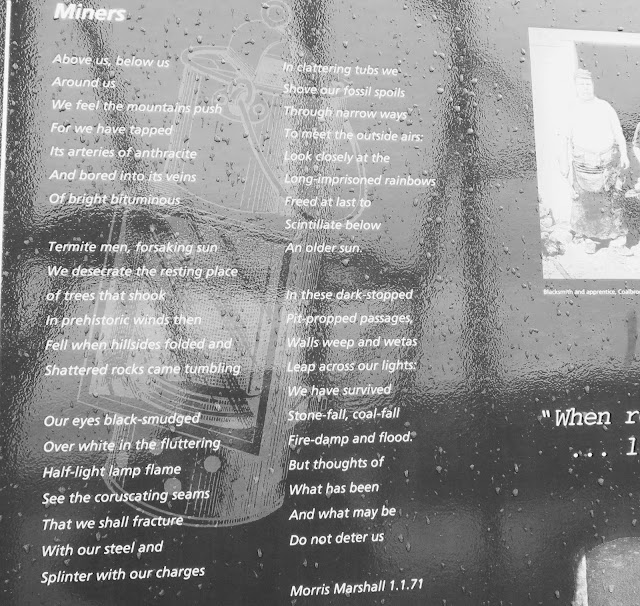
Denniston open-air coal mine museum. West Coast.

After reading this, don't you feel as if you have imagined just a little of how a coal miner felt in those days of hard, dirty and claustrophobic work with danger lurking all around you? Would a narrative have conveyed the same feelings?
Denniston  Read here.

Now try this article- Nugget Point Walkway - by a noted NZ traveller and writer, and not once does she mention the sterling effort our Department of Conservation has undertaken along the Catlins Coast walkway to provide walkway markers that entice you with information in a unique poetic manner!
Space constraints? Well if so, then print publishers are failing to adapt to the unfettered possibilities offered by online publishing where formats can be more expansive.

Nugget Point Walkway to the lighthouse.
Along the walkway there are many markers displaying poetic interpretations of the experience, but have you ever read a travel article that mentions these? That travel writer would be looking for a unique pitch for a story, and yet she ignored this angle!

I feel they add an extra dimension to the walkway experience, encouraging the reader to stop and imagine more about the environment and the forces of Nature that shaped this coast. You pay a lot of money to travel, so why ignore all the offered ways to enjoy a place?
Read the markers so you can always recall this place through the words in your memory. You can take away more than just pictures...your own impressions.

Here are pics of just two of the many markers.

Nugget Point walkway markers, Catlins Coast, Southland.

Positioned so you can look up from the words and see the pounding surf, the wheeling flocks of seabirds setting out or returning to rookeries on the cliff faces, the swirling of bull kelp in the wind-driven crashing waves, or the gentle, almost musical rippling of wind-shorn manuka and kamahi vegetation sheltering yellow-eyed penguin or seal pups.

 He wahi taoka. He wahi taima. A special place. A special time.
Nugget Point Walkway markers, Catlins Coast, Southland, 


The newly created Lake Dunstan, behind the Clyde Dam (completed 1993), flooded most of the old gold mining and sluicing operations throughout the Cromwell Gorge. At a roadside lay-by at the northern head of the lake, just before you reach Cromwell, is a memorial to the gold-rush era pioneers.

Here again, an important fragment of our history memorialised in poetry: a narrative just wouldn't convey the same immortal reverence or importance somehow.

Memorial to our early gold miners, Cromwell Gorge roadside.

St Bathans
St Bathans, in the Maniototo, Central Otago, is reached by a detour off the main highway north of Alexandra. The Loop Road takes you to this historic gold mining village where a few of the original buildings remain. Built of mud brick, the Vulcan Hotel (formerly The Ballarat) stands proud, offering overnight accommodation, ghost included, and great cooking by excellent hosts. Your tour guide around the man-made lake through sluice-tailing mounds of the gold workings, now eroded into a Cappadoccia-like troglodyte landscape, will be the hotel's dog! 

While enjoying coffee and muffins, and a great conversation with Jude, we spied these framed newspaper cuttings.
Once again, poetry brings a deeper immersion in an historic place- yes, you'll hear the ring and clatter of picks and shovel if you just let that imagination have the rein...

Vulcan Hotel, St Bathans, Otago. 

Vulcan Hotel, St Bathans, Otago.

We explored NZ's early history, investigating old coal mining centres, wandering the remnants of goldfields, and browsing country museums.
And each museum memorialises, like a temple of reverence, the history of these small rural communities where families lost their sons, wives lost husbands, and young women faced a life of spinsterhood: a whole generation of men lost! From a population in 1914 of 1,150,000,  just over 100,000 New Zealanders served overseas. A staggering 58,000 casualties ( including over 18,000 dead ) incurred!
Static displays of photos, equipment, and personal diaries and letters record the huge personal loss to these communities. In each museum, maps show the farms and villages that lost so many young men, and women, who are buried on the far side of the world in Belgium, France, Egypt, and at Gallipoli in Turkey. These displays brought home to us an appreciation of the deep effects on our young country's development subsequent to the First World War.

And of course one of the most remembered of war poems is proudly but poignantly displayed in every one of our country museums, drawing one's mind to imagine the bitter consequences of that great human folly.

In Flanders Fields.
By John Macrae, May 1915

In Flanders fields the poppies blow
Between the crosses, row on row,
That mark our place; and in the sky
The larks, still bravely singing, fly
Scarce heard amid the guns below.

We are the dead. Short days ago
We lived, felt dawn,saw sunset glow,
Loved and were loved, and now we lie
In Flanders fields.

Take up our quarrel with the foe:
To you from flailing hands we throw
The torch; be yours to hold it high.
If ye break faith with us who die
We shall not sleep, though poppies grow
In Flanders fields.

Yes, poetry surrounds the traveller. Seek it out, or better still, write it and let's get some published!
He wahi taoka. He wahi taima.

Yeah OK, glad you read to the end. Was supposed to be a few pics of poetry we found on our travel but it ended up a rant on the wider issue of the lack of travel poetry being published today!

Share/Bookmark

Monday, November 19, 2012

Deny me hope- arm me with anger.


Van Gogh: The Olive Trees


Deny me hope: arm me with anger
Just another rocket coming down
Deny me safety: place me in danger
Just another war coming around.
Instead of rainbows colouring our blue skies
Rocket trails criss-cross our lines

You spell God YHWH: I spell God Allah
Your God is the same God as mine
You see through blue eyes: I see through brown eyes
You see the same world as I
But from our shelters, we see no sunshine
Without hope we're both just wasting time.

I have a rocket: you have an airplane
Is this land yours or is it mine?
You have a bulldozer: I have a landmine
there are some who'd love to see us die
You have Merkava: I have the Kornet
Without love your child's as dead as mine.

There is a sandstorm raging with these desert winds
threatening to smother all with sand
Where is the rain cloud to settle this sandstorm
bringing rain upon this thirsty land?
You bring the water, I'll plant the tall trees
Without hate we both could share their shade.


...............................................................................................................................................

The current conflict in the Middle East between Israel and Hamas in the Gaza territory is really concerning. Casualties mount on both sides while the threat of an Israeli ground invasion appears imminent. We can argue rights and wrongs of both sides but with a situation that has roots deep in history the future can only come from compromise and co-existence... if they can be found.

On my Facebook page two friends were firing verbal salvoes at each other on a post I had made about the conflict.
At the same time in my workshop Ray Wylie Hubbard was quietly crooning a song that has always fascinated me. He sings of conflicting elements bound together but ready to break if love cannot hold them together.
"You are a rainbow spread across the blue sky
the sunrise is your next of kin
I am am like a whirlwind roaring across the desert
the kind some hope to never see again
You are a rainbow, I am a whirlwind 
without love, we're both just wasting time."

While listening I began to write down the words above about the conflict.


I have no wish to plagiarise Ray Wylie Hubbards awesome words. He inspired the style and I have borrowed a line from him.
The way he weaves disparate elements together then makes the statement -"..without love, we're both just wasting time " seems to sum up the situation and his words need to be out there.
Without goodwill, hope or compromise where will this end?


Share/Bookmark